Contact center of the Ukrainian Judiciary 044 207-35-46
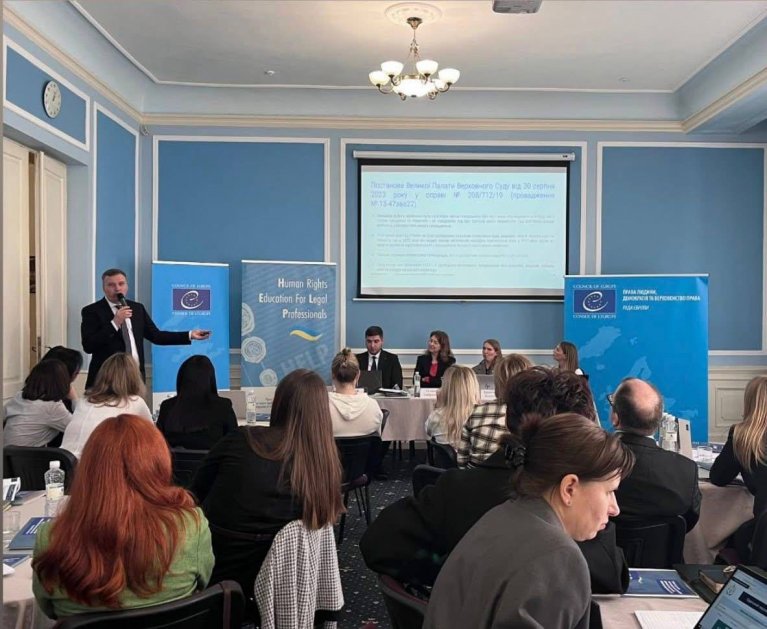
The case law of the European Court of Human Rights (ECtHR) is a real instrument for the protection of human rights, and the Convention for the Protection of Human Rights and Fundamental Freedoms must be interpreted in the light of present-day conditions. This was emphasised by Judge of the Grand Chamber of the Supreme Court Vitalii Urkevych during his address on the course “Admissibility Criteria for Applications Lodged with the ECtHR”, organised by the Council of Europe project “HELP (Human Rights Education for Legal Professionals) for Ukraine, including during wartime. Phase II”.
The speaker recalled the normative foundations for the application of ECtHR case law in Ukraine. In particular, pursuant to the Law of Ukraine “On the Execution of Judgments and the Application of the Case Law of the European Court of Human Rights”, both the Convention and the case law of the ECtHR are applied by national courts as a source of law. At the same time, the judge noted that account must be taken not only of judgments against Ukraine, but also of judgments concerning other States, as well as of cases in which the ECtHR found no violation, since these too contain important legal guidance.
A separate part of the address concerned the rules for using ECtHR case law in legal argumentation. The speaker stressed that any reference to an ECtHR judgment must be appropriate, relevant to the circumstances of the particular case, and consistent with the national legal context. Formal or selective quotation of isolated phrases without regard to the full content of the judgment and the circumstances in which the ECtHR reached its conclusion is inadmissible.
The judge also dwelt in detail on useful resources for working with ECtHR case law. Among them are the official HUDOC database and the Ukrainian-language version of the ECtHR Knowledge Sharing Platform. These resources enable practitioners to locate the necessary judgments, analytical materials and reviews of ECtHR case law under individual Articles of the Convention promptly.
The speaker also spoke about Protocol No. 16 to the Convention, which provides for the possibility of higher national courts requesting advisory opinions from the ECtHR. He recalled that such opinions are not binding, yet they are of considerable importance for the correct application of Convention standards at the national level. Vitalii Urkevych reported that on 5 March 2026, in response to a request from the Supreme Court, Ukraine received the first advisory opinion of the ECtHR in the history of the State. It concerned whether premises of a monastery fall within the category of “home” within the meaning of Article 8 of the Convention, as well as the question of the jurisdiction of the national court in such disputes.
In addition, the speaker noted that the ECtHR has currently accepted for consideration a further request from the Supreme Court in an administrative case in which the question has arisen whether a national court, having found a financial sanction to be disproportionate, may apply a lesser sanction not provided for by law but one that meets the requirement of proportionality.
A separate part of the address was devoted to the review of national court decisions on the basis of ECtHR judgments. It is precisely the Grand Chamber of the Supreme Court that reviews judicial decisions on exceptional circumstances after the ECtHR has established a violation by Ukraine of the provisions of the Convention.
The judge drew attention to the time limits for such an application and noted that, after receiving notification that an ECtHR judgment has become final, the applicant must act promptly and lodge an application for review within 30 days. At the same time, he dwelt separately on the change in the legislative approach concerning the ten-year time limit from the date of the national court’s decision for lodging an application for its review, observing that at present this time limit may be renewed by the court.
The speaker also cited a number of examples from the practice of the Grand Chamber of the Supreme Court which demonstrate the possible consequences of ECtHR judgments for the national legal system.
In particular, in a case concerning a violation of the applicant’s right to the peaceful enjoyment of possessions as a result of the application of a sanction for a breach of customs rules, the Grand Chamber of the Supreme Court, analysing the ECtHR judgment, concluded that it was necessary to exclude the confiscation of monetary funds as a disproportionate measure, while leaving the fine in place. In another case, which concerned a violation of the procedural aspect of Article 2 § 1 of the Convention, the judicial decisions were set aside and a fresh judicial examination of the complaint by the representative of the victim against the decision to close the criminal proceedings was ordered.
Vitalii Urkevych also examined property disputes relating to land relations and the protection of the rights of a bona fide acquirer. He emphasised that ECtHR case law in such categories of cases in fact influences the formation of new legislative approaches in Ukraine. By way of example, the judge referred to the Law of Ukraine “On Amendments to the Civil Code of Ukraine regarding the Strengthening of the Protection of the Rights of a Bona Fide Acquirer”, which provides, inter alia, for a mechanism of compensation to the bona fide acquirer of the value of immovable property by means of the claimant depositing the corresponding sum with the court. Active development of judicial practice on the implementation of these legislative innovations is currently under way.
The speaker stressed that ECtHR case law is an important instrument for the implementation of the provisions of the Convention. A proper understanding and application of this case law are of direct significance both for the protection of human rights and for the development of national judicial practice.
The event was organised in co-operation with the Higher School of Advocacy of the National Association of Advocates of Ukraine and the Co-ordination Centre for Legal Aid Provision.
Photos courtesy of the organisers.
