Contact center of the Ukrainian Judiciary 044 207-35-46
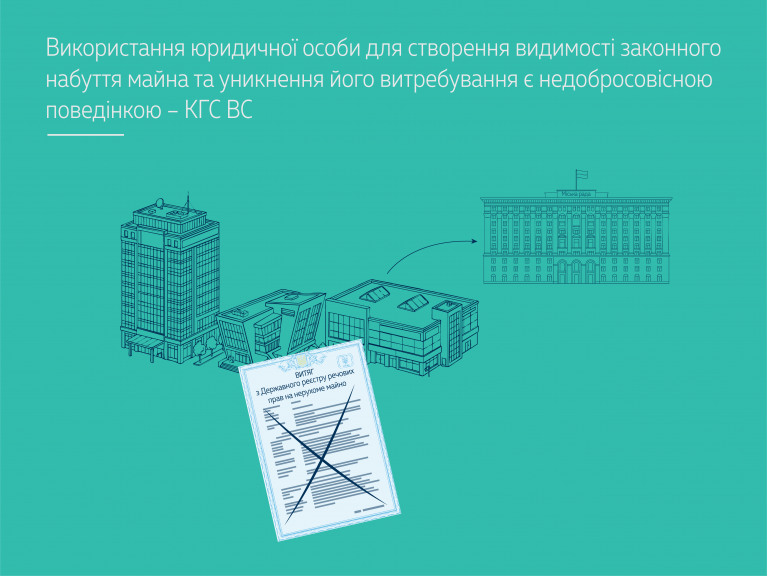
Using the legal-entity structure, in particular by contributing immovable property to its charter capital, as well as other private-law mechanisms, with the aim of creating the appearance of a bona fide acquisition of title and preventing the recovery of the property, constitutes bad-faith conduct and indicates an abuse of rights by participants in civil transactions.
This conclusion was reached by the Commercial Cassation Court within the Supreme Court.
In this case, the prosecutor, acting in the interests of the Kyiv City Council, brought a claim seeking the recovery from a company of non-residential premises and the cancellation of the state registration of title to them.
The premises in dispute were owned by the territorial community of the city of Kyiv.
Previously, a court decision had ordered the recovery of the premises from an individual in favour of the territorial community. At the same time, while that case was being heard, the premises were divided into two separate properties, one of which was subsequently contributed to the company’s charter capital. At the time the property was transferred, the person from whose possession it had been recovered was the director of that company.
The lower courts upheld the claim, finding that the company had acquired the property unlawfully and could not be regarded as a bona fide purchaser.
The Commercial Cassation Court of the Supreme Court noted that a bona fide purchaser is a purchaser who did not know and could not have known that the transferor lacked the right to dispose of the property. At the same time, property may be recovered from a bad-faith purchaser irrespective of the other circumstances in which it was acquired.
When assessing whether the acquisition of property was in good faith, it is necessary to take into account, in particular, the time at which the relevant transactions were entered into, the relationships between the parties to those transactions, and their knowledge of the legal status of the property.
In this case, the company’s director was aware of the court decision ordering the recovery of the disputed immovable property in favour of the territorial community, since the property had been recovered from her possession. Therefore, her contribution of part of that property to the company’s charter capital could not confer bona fide purchaser status on the company.
The Supreme Court emphasised that the division of immovable property, its contribution to charter capital, or the use of other formally lawful private-law mechanisms cannot be used to create the appearance of lawful acquisition of property for the purpose of preventing its recovery by the owner.
Following the cassation review, the Commercial Cassation Court of the Supreme Court dismissed the company’s cassation appeal and upheld the judgment of the appellate commercial court ordering the recovery of the immovable property in favour of the territorial community.
Resolution of the Commercial Cassation Court of the Supreme Court of 29 July 2026 in Case No. 910/2908/25 – https://reyestr.court.gov.ua/Review/138821452.
This and other legal opinions of the Supreme Court are available in the Database of Legal Positions of the Supreme Court - https://lpd.court.gov.ua.
