Contact center of the Ukrainian Judiciary 044 207-35-46
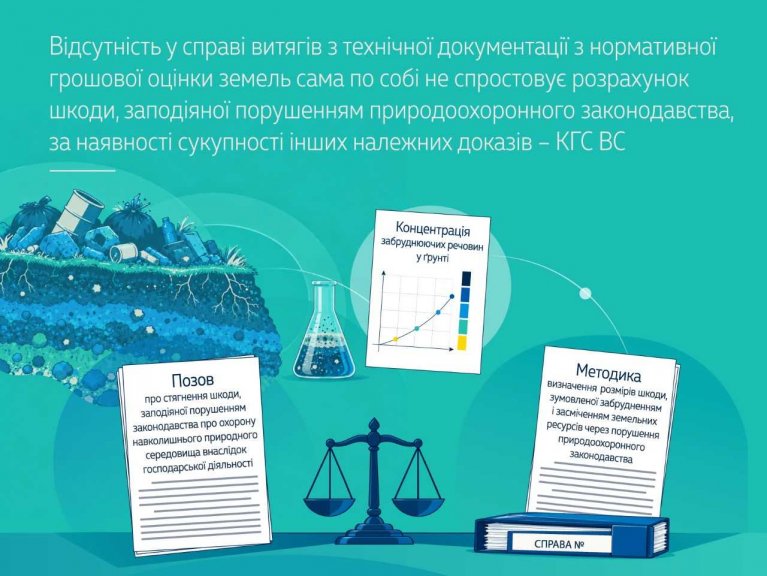
The absence from the case materials of individual extracts from the technical documentation on the normative monetary valuation of land plots is not a ground for refusing to recover damage caused by a breach of environmental-protection legislation if the calculation has been made in accordance with a methodology approved by the competent authority and the defendant has acknowledged the fact of the breach. The combination of an inspection report, a prescription, protocols of laboratory soil tests, a calculation of damage under the mandatory methodology and the defendant’s acknowledgement of the fact of the breach is sufficient to establish all the elements of a civil wrong that are necessary for the recovery of damage.
This conclusion was reached by the Commercial Cassation Court within the Supreme Court.
In the case the State Ecological Inspectorate brought a claim against a private enterprise for recovery of damage caused by a breach of the legislation on the protection of the natural environment resulting from economic activity. During an unscheduled inspection the fouling of land plots with animal-life waste and exceedances of the maximum permissible concentrations of pollutants in the soil were established. The amount of damage was determined in accordance with the approved methodology.
The court of first instance upheld the claim; however, the appellate commercial court set aside that judgment and dismissed the claim, inter alia because the case materials did not contain extracts from the technical documentation on the normative monetary valuation of the land plots, the indicator of which had been taken into account in calculating the damage.
The SC CommCC noted that a claimant in cases concerning the recovery of damage must prove the unlawfulness of the tortfeasor’s conduct, the existence of damage and its amount, as well as the causal link between the unlawful conduct and the damage. At the same time, when determining the amount of losses the court may not confine itself to a formal assessment of an individual piece of evidence but must examine all the evidence submitted and assess it in its entirety.
The Supreme Court indicated that the calculation of damage had been made in accordance with the approved methodology and that the defendant, during the proceedings in the court of first instance, had not rebutted it: he had not alleged incorrectness of the indicators applied, had not applied for the production of the relevant extracts and had not raised the question of appointing an expert examination. Moreover, the defendant had in fact acknowledged the fact of the breach of environmental-protection legislation by requesting an extension of the time-limit for compliance with the requirements of the prescription.
In such circumstances the SC CommCC concluded that the inspection report, the prescription, the protocols of measurements of the composition and properties of the soil, the calculation of damage in accordance with the approved methodology and the defendant’s acknowledgement of the fact of the breach, taken together, constitute sufficient evidence for establishing the elements of a civil wrong and for imposing on the defendant the duty to compensate the damage caused to the State.
The SC CommCC set aside the ruling of the appellate commercial court as having been adopted in breach of the rules of procedural law governing the assessment of evidence and left in force the judgment of the court of first instance.
Resolution of the SC CommCC of 2 September 2026 in case No. 922/3834/25 – https://reyestr.court.gov.ua/Review/139671448.
This and other legal opinions of the Supreme Court are available in the Database of Legal Positions of the Supreme Court - https://lpd.court.gov.ua.
